

Are Expensive Dog Bowls Actually Better?
Table of Contents
- What Makes a Dog Bowl Expensive
- Stainless Steel vs Ceramic Dog Bowls
- Durability and Wear Resistance: Do Premium Bowls Last Longer
- Non-Slip Dog Bowls and Stability
- Are Elevated Dog Bowls Better for Your Pet
- Dog Bowl Safety: What Actually Matters
- Price vs Performance: When Premium Bowls Make Sense
- Frequently Asked Questions
Last Updated: October 7, 2026
What Makes a Dog Bowl Expensive
Dog bowl prices range from under ten dollars to over a hundred.
Quality stainless resists rust, holds temperature, and survives heavy use. But many expensive dog bowls charge premium prices for aesthetics alone: a bowl that tips over with every meal isn't better, just more expensive.
The real cost drivers are non-slip bases, elevated designs, and smart features like heating elements. These justify higher prices because they solve real problems: spills, noise, digestion, and neck strain.
Stainless Steel vs Ceramic Dog Bowls
Stainless steel is durable, temperature-resistant, and nearly indestructible; ceramic offers aesthetic appeal and heat retention but chips and cracks easily.
Stainless steel excels at durability and hygiene: it doesn't absorb bacteria, is dishwasher safe, and won't crack or chip. For rough dogs like many doodles, it's the practical choice.
Ceramic bowls appeal to owners who want their feeding station to match their décor.
The cost difference isn't always dramatic. The Non-Slip Dual-Use Stainless Steel Pet Bowl from Two Doodle Nerds starts at $19.99 in multiple sizes, combining stainless durability with a non-slip base.

| Feature | Stainless Steel | Ceramic |
|---|---|---|
| Durability | Excellent; resists dents and chips | Good; chips easily, cracks under impact |
| Hygiene | Non-porous; won't harbor bacteria | Porous glaze can trap bacteria if chipped |
| Temperature | Stays cool; doesn't retain heat | Retains heat longer |
| Cleaning | Dishwasher safe; easy to dry | Hand wash recommended; requires care |
| Aesthetics | Modern, sleek appearance | Wide range of decorative options |
| Price Range | $19.99-$139.92 | Typically $15-$50 |
Durability and Wear Resistance: Do Premium Bowls Last Longer
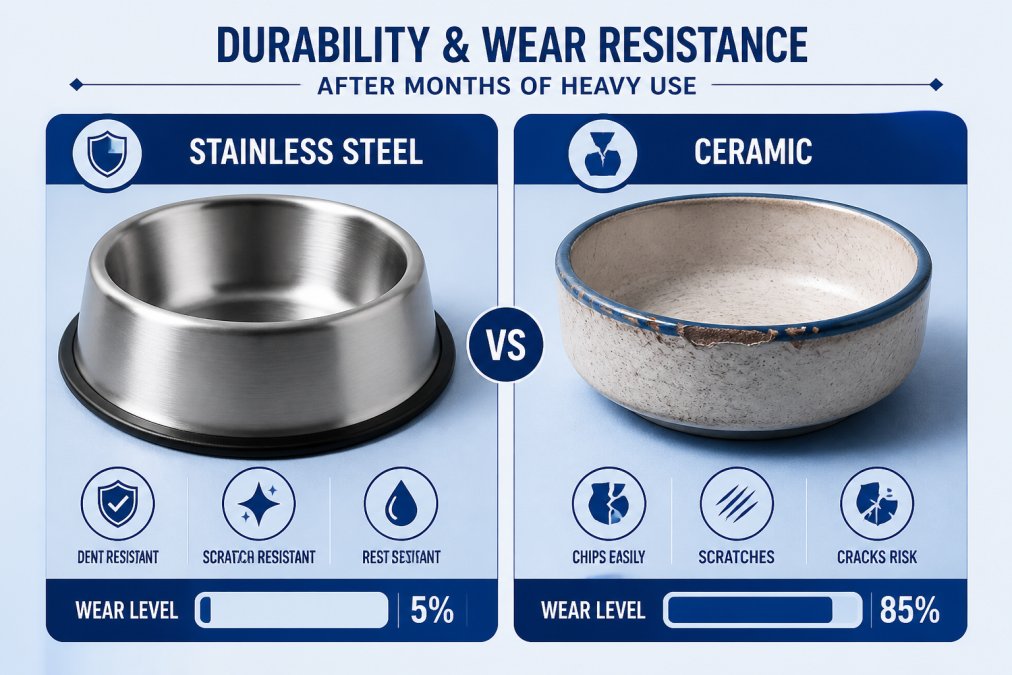
Sometimes, but not always. A premium expensive dog bowl lasts longer only if the price reflects better materials and construction. Many expensive bowls fail because they prioritize looks over durability.
What actually wears out on a dog bowl
Durability is five properties, and a bowl can be strong in one and fail in another:
- Base grip. Rubber rings and silicone feet compress, harden, or peel. Once the grip fails, the bowl slides and the owner often replaces the whole bowl even though the vessel is fine.
- Surface integrity. Stainless steel can develop scratches and, in low-grade alloys, rust spots at weld points or rims. Ceramic chips at the rim or foot. Plastic scratches and discolors.
- Structural rigidity. Thin-gauge stainless dents at the rim and rocks on the floor. Thick-gauge stainless holds its shape. Ceramic cracks under impact. Plastic flexes and eventually stress-cracks.
When you evaluate an expensive dog bowl, ask which of these five the price is actually buying. A bowl that only upgrades the finish isn't more durable, it's just prettier.
How to test durability without a lab
You don't need equipment to compare two bowls. A consistent home test:
- Tip test. Place the bowl on your normal feeding surface (tile, hardwood, LVP). Push the rim with one finger using steady pressure. Note the force it takes to move or tip it.
- Slide test. With the bowl empty, push it across the floor at a normal walking pace. Measure how far it travels before stopping.
- Drop test. From counter height onto the same floor, drop the bowl once. Ceramic will often chip or crack; thin stainless may dent; thick stainless and silicone usually survive.
- Scratch test. Drag a metal spoon across the interior. Deep scratches in plastic trap residue; stainless and silicone resist this.
- Wash cycle test. Run the bowl through 20 dishwasher cycles and re-check the base grip and finish. Rubber that hardens or coating that dulls shows up here.
Run the same test on budget and premium bowls and you'll usually find the price gap is explained by one or two of the five factors, not all of them.
Lifespan and replacement math
Compare bowls by cost per year of use, not sticker price:
- A cheap plastic bowl that scratches, discolors, and gets replaced every 6-12 months costs more per year than a mid-priced stainless bowl that lasts several years.
- A thin-gauge stainless bowl that dents and rusts at the rim in a year or two is not cheaper than a thicker-gauge bowl that holds up for the dog's lifetime.
- A decorative ceramic bowl that chips on the first drop may be replaced more than once, and a chipped ceramic bowl should be retired for hygiene reasons regardless of how it looks.
A well-made stainless steel bowl with a durable or replaceable non-slip base is usually the lowest cost-per-year option. Ceramic and coated bowls cost more per year once breakage and replacement are factored in, even at similar initial prices.
Where premium bowls genuinely last longer
Premium pricing buys longevity when it goes into:
- Thicker stainless gauge at the rim and base, which resists denting and rim deformation.
- Welded or seamless construction instead of glued or press-fit parts that separate.
- Replaceable non-slip feet so a worn base doesn't retire an otherwise good bowl.
It does not buy longevity when it goes into decorative glazes, painted exteriors, novelty shapes, or branding, features that look expensive and still fail the drop test on day one.
A practical durability checklist
Before paying a premium for durability, confirm the bowl delivers it:
- Is the stainless gauge stated, or does the listing only say "stainless steel"?
- Are the non-slip feet replaceable, or molded in?
- Is the stand welded or assembled with plastic connectors?
If a bowl can't answer these questions, the premium buys appearance, not lifespan. If it can, the higher price may pay for itself over your dog's life.
Non-Slip Dog Bowls and Stability
A bowl that slides during mealtime frustrates your dog and creates spills. Non-slip dog bowls solve this with rubberized bases, weighted designs, or textured surfaces that grip the floor.
The Non-Slip Dual-Use Stainless Steel Pet Bowl from Two Doodle Nerds includes a non-slip base engineered to prevent sliding, a feature that alone justifies a higher price than a basic bowl.

Elevated feeders add another stability consideration: a raised bowl on a stand naturally prevents tipping and sliding.
Not every expensive non-slip bowl performs well.
Are Elevated Dog Bowls Better for Your Pet
Elevated dog bowls aren't universally better, they suit specific situations.
Non-Slip Dual-Use Stainless Steel Pet Bowl →
The primary benefit is ergonomic: eating from a raised bowl keeps the neck and spine neutral, reducing joint strain and aiding digestion.
The downside: elevated feeders take more space, cost more, and are harder to move or travel with.
An expensive elevated feeder isn't better than a budget option if both achieve the same height and stability.
Dog Bowl Safety: What Actually Matters
Safety is where expensive dog bowls sometimes justify their cost. Certain materials and designs genuinely protect your dog's health better than cheaper alternatives.
BPA-free materials matter if your bowl is plastic, since some budget plastics leach harmful chemicals into food and water (Plastic Food Container Safety).
Slow-feed designs prevent choking and bloating, genuine safety features that justify higher prices. The Pet Slow Feed Bowl for Dogs to Prevent Choking at $36.80 is engineered to slow eating pace, preventing serious health issues for dogs that inhale their food.

Heating elements add safety through temperature control.
The safety feature that matters most is easy cleaning: any bowl that's hard to clean harbors bacteria and mold.
Price vs Performance: When Premium Bowls Make Sense
It doesn't make sense when you're paying purely for aesthetics. A $100 ceramic bowl that tips over and chips easily isn't better than a $20 stainless steel bowl that stays stable for years.
Match the bowl to your dog's needs and household. A durable stainless steel bowl with a non-slip base covers most dogs for under $40. If your dog has specific concerns, slow eating, elevated feeding, temperature sensitivity, a specialized expensive bowl becomes justified.
A decision framework you can run in two minutes
Instead of asking "is this bowl worth the price," ask four questions:
- Does my dog have a problem the bowl solves? Gulping, choking, bloating, neck strain, sliding, tipping, food theft by another pet, or temperature sensitivity. If no, the premium is decoration.
- Does the cheaper bowl fail at that problem? A basic stainless bowl already solves durability and hygiene. You only need to upgrade if the cheaper bowl can't solve the specific problem.
- Is the premium feature the reason for the price, or is it the finish? A slow-feed insert, a heating element, a weighted base, or an adjustable-height stand are functional. A hand-painted glaze or a designer silhouette is not.
- What's the cost per year? Divide the price by the realistic lifespan. A $40 bowl that lasts 5 years is $8/year. A $25 bowl that gets replaced every year is $25/year. The cheaper sticker is often the more expensive bowl.
Answer all four and you'll know whether the premium is justified for your dog, not a generic dog.
When a premium bowl is not worth it
Clear cases where extra spend buys nothing your dog will notice:
- Your dog eats calmly and normally. No gulping, no tipping, no sliding. A basic stainless bowl with a non-slip base is enough.
- You're buying for looks only. A bowl that matches your kitchen but tips over, chips, or traps residue is a downgrade in function.
- The premium feature doesn't match your dog's size. An elevated feeder sized for a large breed is worse than a floor bowl for a small dog. A slow-feed bowl designed for a big muzzle can frustrate a flat-faced breed.
Total cost of ownership, not sticker price
Owners often compare bowls by purchase price alone. A more useful comparison includes:
- Purchase price.
- Expected lifespan based on material and construction.
- Replacement frequency for parts that wear (non-slip feet, stands, inserts).
A bowl that costs more up front but lasts the dog's lifetime with replaceable feet usually wins on total cost. One that's cheaper but replaced yearly, or chips and becomes unsafe, usually loses. The premium is justified when it reduces replacements, not when it just changes the look.
Matching the bowl to the dog, not the trend
Premium bowls are marketed as universally better. They aren't. The right bowl depends on the dog:
- Large breeds and seniors benefit most from elevated feeders and wide, stable bases.
- Flat-faced breeds often do better with shallow, wide bowls rather than deep slow-feed designs.
- Fast eaters benefit from slow-feed inserts, but only if the insert is removable for cleaning.
Two Doodle Nerds offers options across the price spectrum: the Intelligent Dog Slow Feeder Training Bowl at $19.99 provides entry-level slow-feed functionality, the Silicone Non-Slip Pet Bowl at $38.21 adds premium materials and slow-feed design, and the Round Stainless Steel Smart Heating Bowl Feeder at $139.92 combines multiple premium features for dogs with specific needs.
The question isn't whether expensive dog bowls are better, but whether the specific bowl you're considering addresses a need your dog has. A premium bowl that solves zero problems is just an expensive bowl; a budget bowl that prevents choking or reduces joint strain is money well spent.
Frequently Asked Questions
Are expensive dog bowls really better than cheap ones?
Not necessarily. Expensive dog bowls often offer better durability, superior non-slip bases, and aesthetic appeal, but a budget-friendly stainless steel bowl can perform just as well for everyday feeding. The difference matters most if your dog is rough on things, eats quickly, or has specific health needs like slow feeding. For most pets, a mid-range option with a non-slip base and easy-clean material meets all functional requirements without premium pricing.
What material is safest for a dog bowl?
Stainless steel and food-grade ceramic are the safest materials for dog bowls. Stainless steel resists bacteria, doesn't chip or leach chemicals, and lasts for years. Ceramic is safe when glazed properly and chip-free, but damaged ceramic can expose clay underneath. Avoid plastic bowls for regular feeding since they can scratch, harbor bacteria, and may contain BPA. Always choose BPA-free options if you do use silicone or plastic, especially for slow-feed bowls designed for specific health needs.
Do stainless steel dog bowls last longer than ceramic ones?
Yes, stainless steel bowls typically outlast ceramic. Stainless steel resists denting, chipping, and staining, making it ideal for active dogs or heavy daily use. Ceramic bowls can crack or chip if dropped or knocked around, requiring replacement. For a durable dog like a Doodle that sheds heavily and plays rough, stainless steel offers better longevity and lower replacement frequency, reducing your total cost of ownership over time.
Are elevated dog bowls better for dogs?
Elevated bowls can benefit certain dogs but aren't necessary for all. They reduce strain on the neck and spine, which helps large breeds or senior dogs with joint issues. However, they're not required for typical feeding and don't improve digestion or prevent bloating on their own. If your dog has arthritis or you prefer ergonomic feeding, an elevated option is worth considering. For healthy, medium-sized dogs, a standard bowl on the floor works fine, so elevated feeders are a preference rather than a must-have.